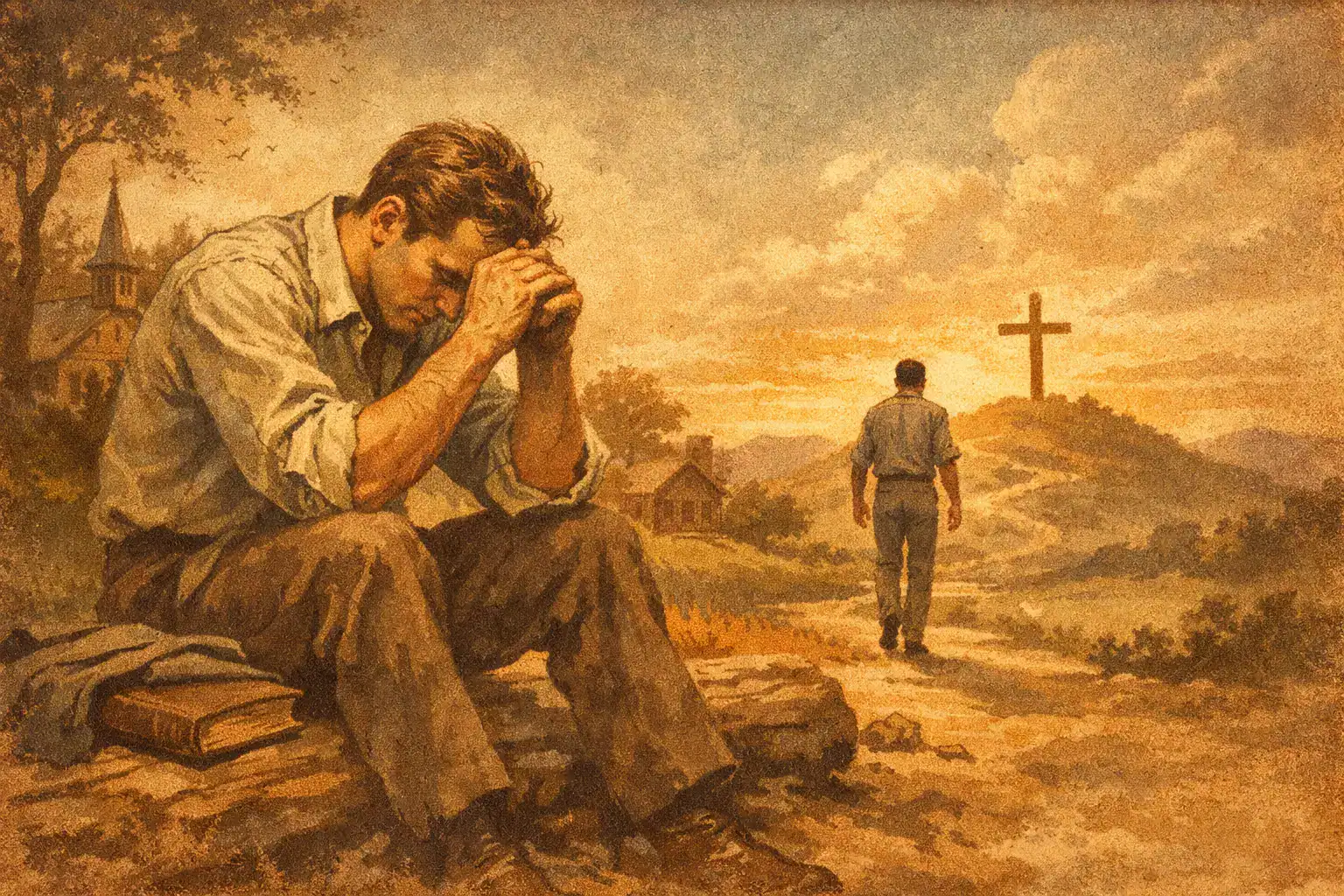

Everytime you say YES to one thing, you are saying NO to a thousand others. Every choice has a cost.
A promotion arrives with more money, but demands travel that would pull you away from your wife and children. A business opportunity promises growth, yet its terms leave you uneasy. A conflict at home requires a hard conversation, and delaying it feels easier than leading it.
These are more than productivity problems. These are moments that reveal whether faith-based decision making is shaping your life or whether anxiety, fear, pride, and worldly expectations are quietly taking the lead. A Christian man is called to act with courage and responsibility, but courage is not just jumping into the fire. It is the willingness to choose what is right when the cost is very real.
God has given you a mind to reason, responsibilities, relationships, and talents to steward. Faithful decisions honor all four. They do not require perfect certainty before action, nor do they reduce prayer to a constant request for some kind of sign. They form a steady pattern of seeking God first, examining your motives, weighing the facts, receiving wise counsel, and taking the next faithful step.
Why Faith Based Decision Making Requires More Than Instinct
Instinct can be useful. It was given to us for a reason. It is especially useful when trained. But instinct alone is easily influenced by exhaustion, resentment, financial pressure, the need for approval, or the desire to avoid discomfort. What feels peaceful is not always wise. Sometimes peace comes after obedience, not before it. Sometimes peace comes when the enemy stops worrying about you.
Scripture gives Christian men a better foundation. Proverbs calls us to trust in the Lord rather than lean solely on our own understanding. James teaches us to ask God for wisdom. Christ tells His disciples to count the cost. These are not competing or contradictory instructions. Together, they show that faithful discernment includes dependence on God and honest thought.
The decisions that shape a legacy are rarely the times of life which are dramatic in the moment. They are often ordinary. Think about; how you use an evening, whether you keep your word, how you respond when criticized, what habits you allow into your home, and whether your work supports or slowly consumes the life you say matters most.
A good decision may still involve high cost. Turning down a lucrative role can limit income. Setting a boundary with a demanding client can slow business growth. Seeking reconciliation may expose you to rejection. Faithfulness is not a formula for an easy life. It is a commitment to pursue what is good, true, and rightly ordered even when a shortcut is right in front of you.
A Faith Based Decision Making Process You Can Practice
When a choice carries weight, avoid making it in the emotional heat of the moment whenever possible. Give the decision enough space for truth to surface. This does not mean drifting in indecision. It means creating order before you act.
Begin with prayerful honesty
Bring the actual decision before God, not a polished version of it. Name what you want, what you fear, and what you may be tempted to protect. You might pray, “Lord, show me where ambition has become vanity, where fear has become avoidance, and what faithfulness requires of me. Show me where I am wrong”
Honesty matters because hidden motives distort discernment. A man may call a move “providing for my family” when he is really chasing status. Another may call passivity “waiting on God” when he is avoiding the risk of failure. Prayer is not an escape from self-examination. It is where self-examination becomes possible without despair.
Test the decision against clear Christian commitments
Sometimes it is not that complicated. God’s will is not mysterious in every respect. A decision should not require dishonesty, cruelty, betrayal of marital vows, neglect of children, exploitation of others, or contempt for the duties already entrusted to you. No opportunity is God-given if accepting it requires you to violate what God has already made clear. Other times it may take more discernment and prayer.
This is where many men need clarity. You do not have to agonize over whether a path is right if its foundation is plainly wrong. Remove options that compromise your integrity before comparing the remaining choices.Reach out to other men of faith to explore how it aligns.
Also consider your vocations. You may be a husband, father, son, employee, employer, church member, neighbor, and friend. Not every role carries the same urgency in every season, but no role should disappear from the equation simply because one ambition is demanding more attention.
Gather the facts and count the cost
Faith should not reject practical planning. If you are considering a new job, know all the fact(or)s; the compensation, schedule, travel expectations, advancement path, and impact on family life. If you are starting a business, understand the financial exposure, the time required, and the burden placed on those who depend on you.
Vague decisions create anxiety because they leave room for fantasy. Put the facts on paper. Identify the best likely outcome, the hard likely outcome, and the outcome you would need to be prepared to carry. Don’t think of this as pessimism. It is responsible stewardship.
Here is a simple question to ask: if this decision succeeds exactly as expected, what will it cost me in the areas of faith, relationship, energy, and impact? A gain in one area can become a loss in another. The honest answer depends on your season, obligations, and capacity, but you should know the trade-off before you commit.
Seek counsel from men who will tell you the truth
Beware confirmation bias. Wise counsel is not collecting opinions until someone agrees with you. It is inviting mature people to examine the decision with you. A priest, pastor, trusted elder, experienced mentor, or grounded friend may see a blind spot you cannot see from inside the pressure.
Choose counsel carefully. Look for men whose lives show integrity, responsibility, and love for their families. Ask them direct questions: “What might I be missing?” “Where do you see fear or pride in me?” “What would faithfulness look like if the easier path were unavailable?”
You remain responsible before God for the decision. Counsel does not transfer that responsibility. It strengthens your judgment and protects you from making major choices in isolation.
Decide, then build a faithful next step
At some point, more analysis becomes delay. Once you have prayed, tested the matter, gathered relevant facts, and sought counsel, make the best faithful decision you can. Do not demand a level of certainty that God has not promised.
Then turn the decision into action. In the case of a potential new role. If you accept the role, then establish non-negotiable boundaries for family time and worship before the first week gets crowded. If you decline it, make a plan to strengthen your finances rather than merely hoping the pressure goes away. If you need to repair a relationship, schedule the conversation and prepare to listen without defending yourself.
Clarity becomes useful only when it produces obedience. A decision without a next step often becomes another form of distraction.
When You Still Do Not Know What to Do
There are times when two options appear morally sound. You may be choosing between two jobs, two places to live, or two worthwhile paths of service. In these cases, do not assume that uncertainty means you have failed to hear God.
God often guides His people through wisdom formed over time. Consider which path better serves your present responsibilities, uses your gifts, supports the health of your household, and allows you to act with greater integrity. Pay attention to patterns, not just passing emotions. A single difficult day does not prove a path is wrong, just as a moment of excitement does not prove it is right.
If neither choice violates your duties and both can be pursued honorably, you may have genuine freedom to choose. Receive that freedom with gratitude, then commit yourself fully. Second-guessing every step can be the enemies weapon keeping you from moving forward.
Make Decisions From a Life of Order
Major choices are easier to discern when your ordinary life is not ruled by chaos. A man who is chronically exhausted, spiritually neglected, financially disorganized, and emotionally reactive will struggle to hear anything clearly. His immediate need will often feel like his highest calling.
This is why transformation must reach beyond a single decision. The 3|4 Method addresses the connected domains of Faith, Relationship, Energy, and Impact because each one affects the others. Prayer is harder when your mind is scattered. Patience at home is harder when work has no boundaries. Meaningful impact is harder when you have not named the habits that keep pulling you off course.
Start smaller than you think you need to. Take a 20-minute reset at the beginning or end of the day. Put your concerns before God. Review your commitments. Identify one decision you have been avoiding and one faithful action you can take this week. This practice will not remove every hard choice, but it will train you to meet pressure with greater steadiness.
Your legacy will not be built by waiting for a life with no uncertainty. It will be built each time you choose truth over convenience, responsibility over escape, and faithful action over fear.
You do not have to work through this decision alone. A free coaching call with Pure Life Mastery gives you a place to test your thinking and get direction on the next faithful step. Bring the decision you are facing and the questions you have been avoiding. Visit www.purelifemastery.com/free and reserve your call today.