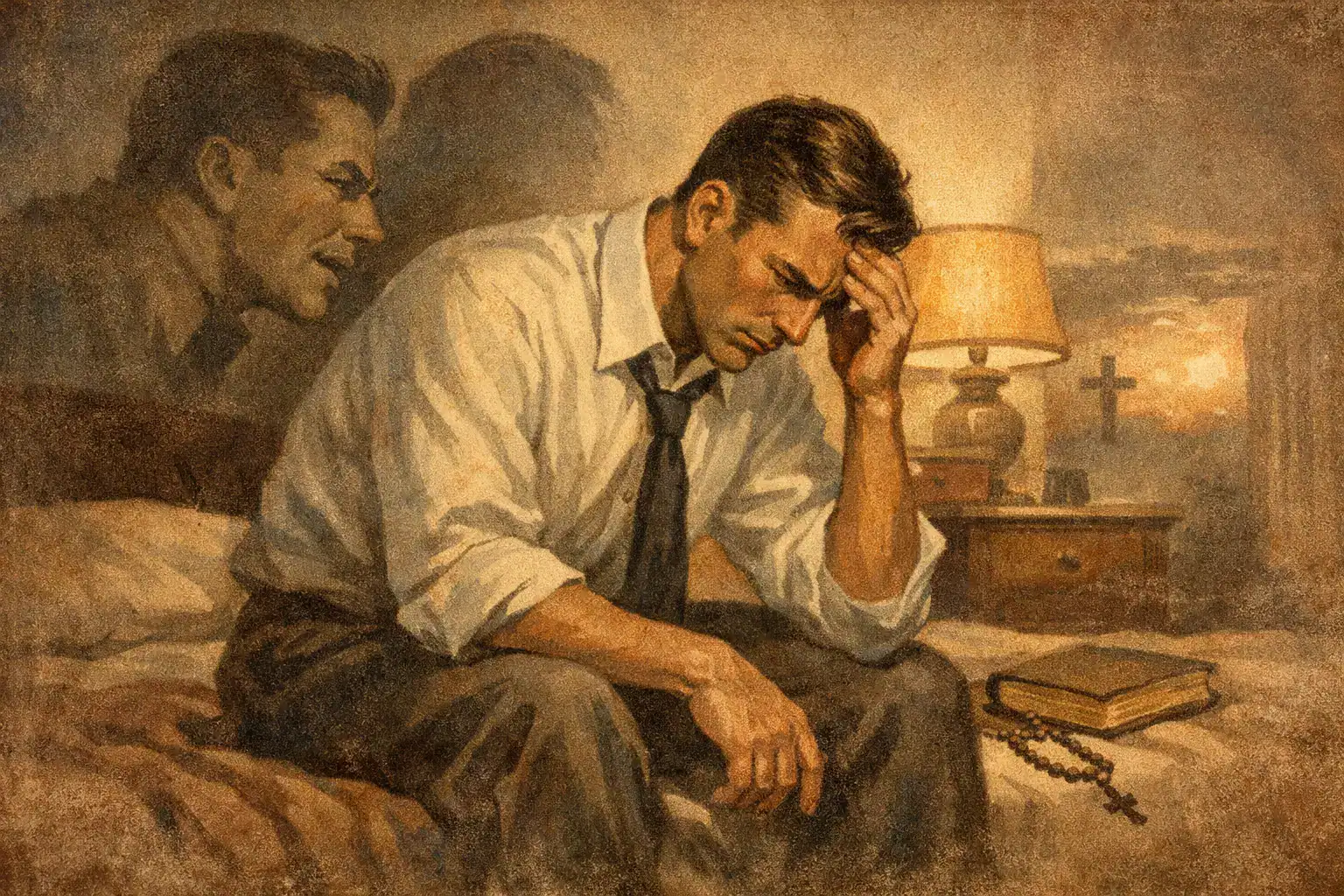
Anxiety rarely announces itself at the front door. For many men, it arrives as a clenched jaw in a meeting, a short temper at home, a mind that rehearses disaster at 2 a.m., or an endless urge to stay busy.
Christian men’s anxiety support begins by calling this struggle what it is, without shame and without surrendering responsibility. You are not weak because your nervous system is under strain. You are a man who needs truthful support, ordered action, and the grace to receive help.
A faithful life does not require pretending that fear is absent. Scripture gives us men who grieved, trembled, questioned, and cried out to God. Courage was not the absence of distress. It was the decision to remain obedient, present, and dependent on God in the middle of it.
Why Anxiety Can Feel So Isolating for Christian Men
Many men have been trained to be useful before they are honest. They provide, solve problems, protect the people they love, and keep going. These are honorable instincts. But when the same man believes he must carry every burden silently, strength can become isolation.
Anxiety also has a way of disguising itself as virtue. Constant work can look like diligence. Controlling every detail can look like leadership. Emotional withdrawal can look like calm. Yet if your work is driven by dread, your leadership by fear, or your silence by exhaustion, the cost will eventually touch your faith, relationships, energy, and impact.
The answer is not to become self-absorbed or to make every difficult feeling the center of life. The answer is to become more truthful. A man who can say, “I am struggling, and I need wise support,” is not abandoning his duties. He is taking responsibility for the condition of his inner life so he can fulfill them more faithfully.
Christian Men’s Anxiety Support Starts With Honest Naming
Before you can respond wisely, you need to notice what is actually happening. Anxiety is not always a single problem with a single cause. It may be connected to prolonged stress, unresolved grief, conflict in marriage, financial pressure, poor sleep, trauma, a medical condition, or patterns of thought that have grown stronger through repetition. Often, it is several of these at once.
Instead of simply saying, “I am stressed,” give the experience a clearer name. Is your mind predicting catastrophe? Are you avoiding a conversation? Do you feel physically restless, irritable, numb, or unable to focus? Have you stopped enjoying prayer, work, or time with your children because your mind will not settle?
This naming is not indulgence. It is clarity. A man cannot lead what he refuses to see.
Separate Fear From Fact
An anxious thought often speaks with certainty: “I will fail,” “My family will suffer,” or “I cannot handle this.” Do not accept every thought as a verdict. Write down the fear, then ask what facts support it, what facts challenge it, and what next action is actually yours to take.
You may not be able to guarantee an outcome. You can prepare for a meeting, have the needed conversation, review the budget, make the appointment, apologize, or rest. Faithfulness is often more concrete than anxiety wants it to be.
Bring the Whole Burden Before God
Prayer is not a technique for forcing yourself to feel better. It is communion with the living God, who knows your limits and does not despise your need. Bring Him the unedited truth: the fear, anger, weariness, and desire for control. Then remain long enough to receive correction as well as comfort.
A simple pattern can help when your thoughts are racing. Begin with gratitude for what is true and given. Confess where fear has led you toward control, resentment, avoidance, or despair. Ask for daily bread, not a complete map of the next five years. Close by placing one concern explicitly into God’s care and choosing one faithful act for the day.
The historic practices of the Church can also give structure when feelings are unreliable. Attend the Divine Liturgy, Mass, or Sunday worship consistently. Receive the sacraments according to your tradition. Pray the Psalms aloud. Keep a short rule of prayer rather than waiting for a perfect emotional state. These practices do not make hardship disappear, but they retrain your attention toward reality: God is God, you are His creature, and you are not meant to carry the world alone.
Rebuild Order in Your Body and Schedule
A spiritual response should not ignore the body. Lack of sleep, excessive alcohol, constant news consumption, too much caffeine, inactivity, and a chaotic schedule can intensify anxiety. This does not mean anxiety is merely a lifestyle problem. It means your physical habits can either add fuel to the fire or help create conditions for steadiness.
Start modestly. Establish a regular bedtime and wake time most days. Eat real meals. Walk outdoors. Put your phone away for the first and last part of the day. Reduce stimulants if they make you more agitated. Create a brief transition between work and family life so you do not bring the office directly to the dinner table.
Do not turn this into another perfection project. The goal is not an optimized life. The goal is enough order that your body and mind have room to recover.
Use a 20-Minute Reset When Pressure Spikes
When anxiety surges, do not demand that yourself solve your entire life. Take twenty minutes to interrupt the spiral. Step away from the screen. Breathe slowly. Put both feet on the floor. Write down the immediate concern and the next responsible action. Pray a short Psalm or a familiar prayer. Then return to the task in front of you.
This is not denial. It is a refusal to let a moment of panic become the ruler of your decisions. Repeated resets build a habit of returning to clarity.
Let Trusted People Carry Part of the Weight
Isolation gives anxiety a private courtroom where fear acts as judge, witness, and prosecutor. Bring your struggle into the light with a mature friend, priest, pastor, mentor, or counselor who is capable of both compassion and candor.
Choose carefully. You need someone who will not minimize your pain with shallow religious phrases, but neither should he simply validate every fearful conclusion. Wise support listens, asks honest questions, reminds you of your duties and your dignity, and helps you identify the next right step.
If anxiety is persistent, worsening, interfering with work or relationships, causing panic attacks, or leading you to use alcohol, pornography, anger, or isolation to cope, seek professional help. A licensed therapist and, when appropriate, a physician can help assess what is happening and provide treatment. Counseling, medication, and Christian faith are not enemies. The right course depends on your circumstances, medical history, symptoms, and the quality of care available.
If you are considering harming yourself or someone else, seek immediate emergency help or contact the 988 Suicide & Crisis Lifeline by calling or texting 988 in the United States. Tell a trusted person near you and do not remain alone with the crisis.
Build a Rule for the Life You Want to Lead
Anxiety often grows where life is fragmented. You may care deeply about God, your marriage, your children, your work, and your health, yet have no practical structure for giving each area the attention it requires. A written rule of life helps turn broad intentions into lived commitments.
Keep it realistic. Decide when you will pray, when you will train or walk, how you will protect dinner or family time, what financial task needs attention this week, and which conversation you have been avoiding. Review these commitments weekly. Where you fail, do not collapse into self-condemnation. Adjust, repent where needed, and begin again.
This is the kind of integrated growth Pure Life Mastery seeks to cultivate through the 3|4 Method: not isolated motivation, but deliberate progress across Faith, Relationship, Energy, and Impact. Anxiety loses some of its power when your life is no longer governed by whatever feels most urgent in the moment.
Choose Faithful Action Before You Feel Ready
You may wait a long time if you require total inner peace before taking action. Some days, the faithful choice will be made with a racing heart. You send the email. You attend the appointment. You tell your wife the truth. You go to church. You put your phone down and sit with your child. You make the call to a counselor.
That does not make the anxiety unreal. It proves that fear does not have final authority over the man God is forming. Take the next clear step today, and let that act of responsibility become part of the legacy you are building.
You do not have to manage this on your own. A free coaching call with Pure Life Mastery gives you a place to talk through what you are carrying and get direction toward steadier ground. Bring your questions and the areas where fear has taken the lead. Visit www.purelifemastery.com/free and reserve your call today.